Last Updated on October 27, 2026
A hair drug test consultation can mean two different things. It is either the collection appointment, where a technician cuts a hair sample for an employer’s order, or a conversation with a specialist before the test about your own situation. This guide covers both: what happens at each, what to bring, what the test can and cannot see, and when personal advice is worth paying for.
TL;DR
- The collection appointment is simple: bring photo ID and your employer’s order or authorization, plus a list of any prescription medications.
- A standard head-hair sample reflects up to about 90 days of use, so the answer to “will it show?” depends on what you used, how often, and when.
- Hair cannot be tested for drugs at home with any reliable kit. The analysis is done in a laboratory.
- A preparation consultation is about your specific history: substance, date of last use, and frequency over the past 90 days.
- If a result looks wrong, you can ask for a Medical Review Officer (MRO) review, and you can question how the sample was collected.
Table of Contents
- Two meanings of “consultation”
- What happens at a hair test collection appointment
- What a hair test can see
- Can you take a hair drug test at home?
- What does a hair drug test cost?
- The other consultation: preparing before the test
- Perspective: what we tell people on the phone
- Personal consultation with us
- Can shampoo or detox methods change a hair test?
- If a result looks wrong
- Choosing the right kind of help
- FAQ
- Sources
Two meanings of “consultation”
People searching this phrase usually land on lists of collection sites by city. Those pages help if you have been told to show up for a test. They do not help if your real question is “I have a hair test coming and I am worried about what it will find.”
So it helps to separate the two:
- The collection appointment. A scheduled visit at a lab or collection site. Its purpose is to take the sample under a documented process and send it for analysis.
- The preparation consultation. A private conversation with someone who knows hair testing, about your exposure history, your hair, and the date of your test.
The first is administrative and the same for everyone. The second is personal, and it is where most of the useful decisions get made.
What happens at a hair test collection appointment
An employer-ordered hair test generally runs in four steps: the employer places the order, the sample is collected, a laboratory tests it, and the result is reported, usually through an MRO. A published preparation guide from a US collection provider lays out this sequence and the paperwork involved.
What to bring
- A valid photo ID, such as a driver’s license or passport.
- The employer’s order confirmation or authorization form, whichever you were sent.
- A list of current prescription medications, because the MRO may need it when verifying a result.
The same guide notes the MRO uses that medication list in verification. Bring the real list, with doses, rather than trying to remember it in the room.
What the collection looks like
The collector cuts a small sample of head hair close to the scalp. The sample is sealed, labeled, and logged on a chain-of-custody form that you sign. That form matters later if anyone questions the result. Ask for your copy and read your name, the date, and the ID numbers before you sign.
If your head hair is very short or absent, collectors can sometimes take body hair instead. The window for body hair is different and can be much longer, which we explain in our piece on body hair drug tests.
What a hair test can see
The 90-day window
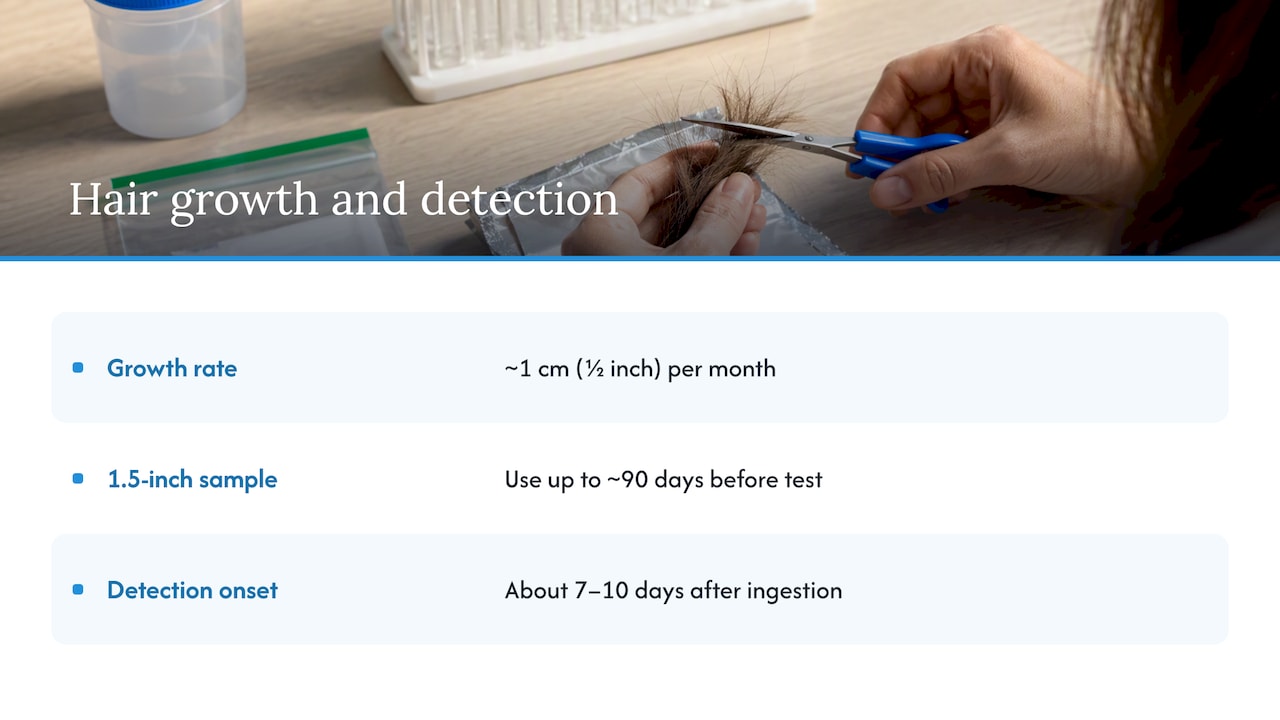
A 1.5-inch sample of head hair reflects use up to about 90 days before the test, according to Labcorp’s hair testing FAQ. The same page notes that detection depends on dose, test sensitivity, duration of use, the drug or metabolite involved, and how the body clears it.
The math behind it is hair growth. SAMHSA’s clinical guidance puts growth at roughly 1 cm, or about half an inch, per month. A 1.5-inch segment therefore covers roughly three months. The same document says drugs typically show up in hair starting about 7 to 10 days after ingestion, which is why a hair test tells you little about use in the last week.
The 90 days are a rule of thumb, not a guarantee. Slow growth, long hair, or heavy use can complicate the picture. We go through those cases in our hair drug test timeline guide and in the piece on long hair and the 1.5-inch rule.
What it screens for
Standard panels cover amphetamines, cocaine, opiates, PCP, and marijuana metabolites. Expanded panels can add benzodiazepines and fentanyl, as one national testing provider describes. Alcohol testing by hair is a separate analysis and only happens if the employer or court orders it. Your authorization form should say which panel applies. If it does not, ask the employer, not the collector.
Why hair results are not simple
Drugs get into hair from the bloodstream, but they can also arrive from the environment. SAMHSA identifies that as a major limitation in separating actual use from passive exposure. An Italian study of external cocaine contamination found that after a single exposure, cocaine and its metabolite stayed detectable for up to 10 weeks, and even rigorous decontamination could not tell the contaminated subject from a user.
That cuts both ways. It is a reason to take a surprising positive seriously, and a reminder that labs are working with imperfect tools.
Can you take a hair drug test at home?
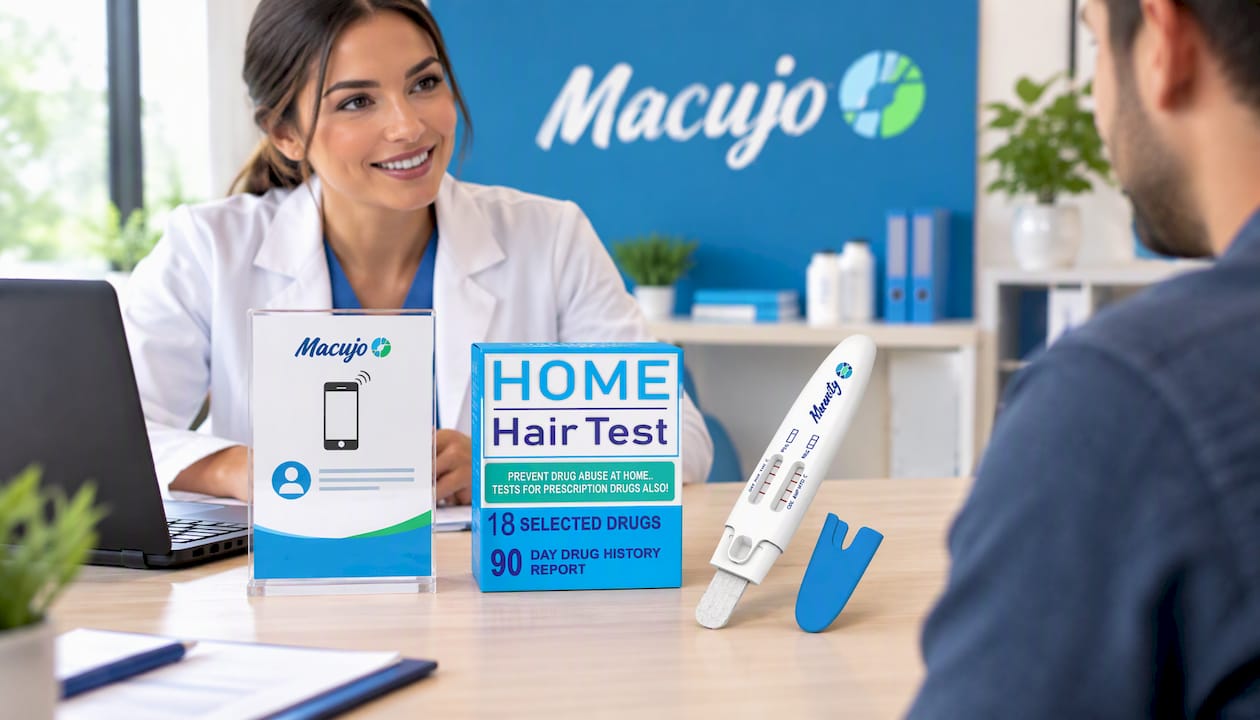
No reliable one exists. SAMHSA’s guidance says hair testing needs a laboratory chemical process to break down the hair and identify the compounds in it. Anything sold for “home hair testing” still depends on mailing a sample to a lab, and it will not substitute for the test your employer orders.
If you want a quick home check before an actual test, urine and saliva screens are a different matter, with much shorter detection windows. Hair and body-fluid results are not comparable.
What does a hair drug test cost?
The price depends on the panel. A basic five-panel test costs less than an expanded panel with extended opiates or a ten-panel screen, and providers set their own fees. Most people never see the bill, because the employer orders and pays for the test. If you are paying yourself, for a court, a custody matter, or your own peace of mind, get the price in writing for the specific panel before you book.
The other consultation: preparing before the test
The collection appointment does not give advice. The collector’s job is process, not guidance. If you are anxious about the result, the useful conversation happens earlier, and it works best when you arrive with specifics.
What to have ready
- The substance or substances involved.
- The date of your last use. Be exact if you can.
- How often you used in the previous 90 days: once, weekly, daily.
- Your test date and panel, and whether it is head hair or body hair.
- Hair treatments: bleach, dye, perms, relaxers. They change how drugs sit in hair. Our article on dyed hair and hair drug tests explains the effect.
- Hair length, since only the first 1.5 inches from the scalp is normally tested.
With that information, a specialist can tell you whether your exposure falls within the window, whether your hair length changes anything, and how much time you realistically have. For the background on how labs process samples, see how hair drug testing actually works and our overview of hair drug testing.
Perspective: what we tell people on the phone
We have helped people prepare for hair tests since about 1999, and the same patterns come up in nearly every call.
First, people underestimate how much detail matters. “I smoked a few times” and “I smoked every day until three weeks ago” are different problems, and no honest answer can ignore that. That is why our required-washes calculator asks for the substance, the date of last use, and your frequency over the previous 90 days, rather than giving everyone the same number.
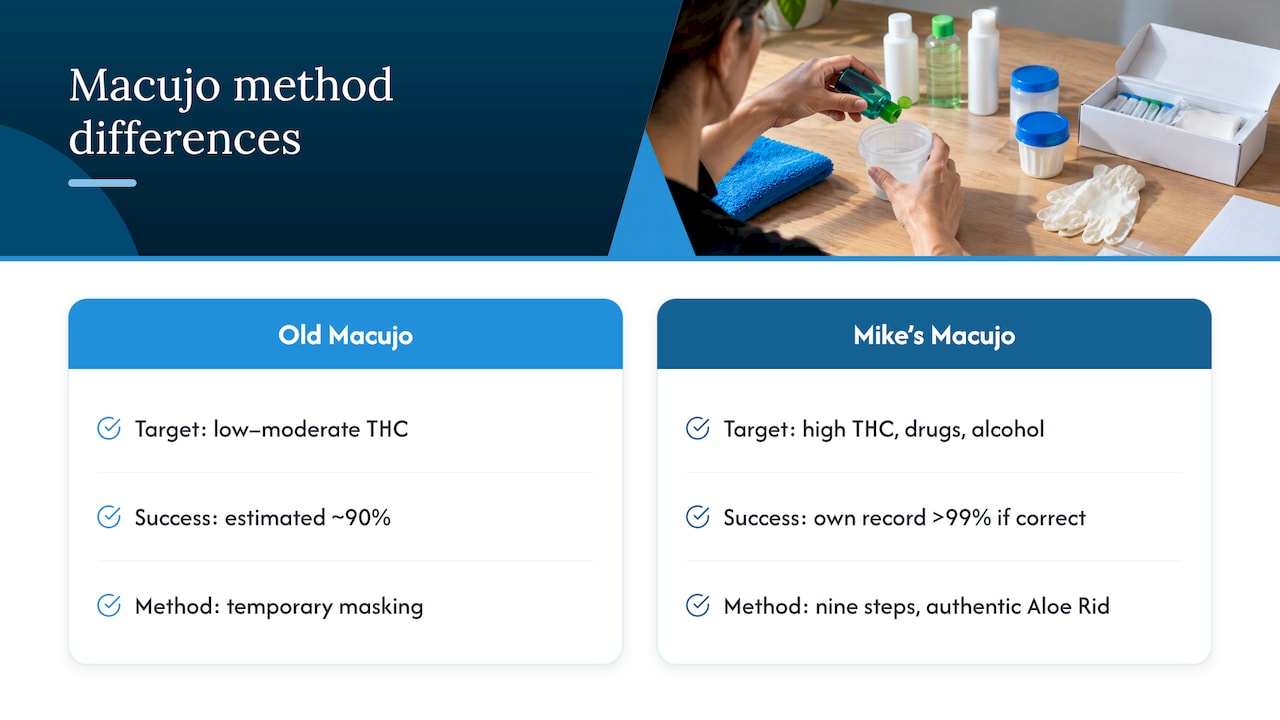
Second, a method has to match the exposure. Our old Macujo Method was built mainly for low-to-moderate THC exposure, and we estimate about 90% success for moderate THC. It only masks temporarily. Mike’s Macujo Method, introduced in 2018, is a nine-step process built for high THC levels and other drugs and alcohol. It must be done with authentic Macujo Aloe Rid Shampoo, and the number of washes comes from the calculator. When every required wash and direction is completed correctly, we report a success rate better than 99%, and the hair stays clean unless there is new use. That figure is our own record, not an independent study, and we say so plainly.
Third, we do not pretend the science is settled. The research is mixed, and we describe it below. What we can say from experience is that skipped steps and shortcuts cause most of the failures we hear about.
Fourth, time is the one thing we cannot manufacture. If you are a heavy user with a test next week, call us rather than guessing.
— MIchael
Personal consultation with us
We offer an Afterhours Personal Consultation for $100. It is a phone conversation, available outside regular business hours, where we go through your history and test date and build a plan around them. If you are not sure which approach fits, book the Afterhours Personal Consultation. If you already know you need the shampoo, the Macujo Aloe Rid Old Formula Shampoo is listed at $100 to $150. For urine and saliva tests, the full range is on our home page.
Can shampoo or detox methods change a hair test?
The honest answer has two sides, and you should hear both.
SAMHSA’s guidance says hair-cleansing shampoos and home methods can reduce drug concentrations in hair, sometimes enough to affect a result. It also says there is no scientific evidence they reliably or completely remove drugs, and that their use can complicate forensic interpretation.
A 2022 German study tested commercial products on THC-containing hair. Vodka, hair tonic, a medicated shampoo, disinfectant, and a common dandruff shampoo cut THC concentrations by an average of 52% to 65%, and in some cases to non-detectable levels. The authors recommend pairing hair abstinence checks with urine analysis and caution against over-reading THC numbers in hair.
What follows for you:
- Washing changes hair concentrations. That much is documented.
- Results vary with starting concentration, product, and protocol. A single rinse and a structured nine-step routine are not the same thing.
- Labs have no common decontamination standard. A 2025 review in the Journal of Applied Laboratory Medicine notes that results can differ depending on the washing protocol the lab uses, which limits how far quantitative numbers can be trusted.
This is why we push people to follow the calculator and every step instead of improvising. Partial effort gives partial results.
If a result looks wrong
A positive hair result is not always the end of the road. You can act in a few ways:
- Ask for an MRO review. The MRO can discuss prescription interference and other explanations with you before a result goes to the employer.
- Check the chain of custody. Gaps in the sample’s documentation are a legitimate procedural challenge.
- Consider independent forensic advice if the matter is legal, such as custody or probation.
- Ask about the confirmation method. Forensic toxicologists writing in Clinical Toxicology stress that immunoassay screening alone is not enough for legal decisions and needs mass spectrometry confirmation.
- Remember the passive exposure problem described earlier. It is a real, documented limitation, though it will not always be accepted as an explanation.
If you did fail, the 90-day window also works in your favor over time. Our guide to verifying a failed hair test and retesting covers how to plan the next step. You can find more on our blog.
Choosing the right kind of help
A short checklist for deciding what you need:
| Your situation | What you need |
|---|---|
| You have an order and an appointment date | Photo ID, the authorization form, medication list |
| You are unsure how far back your exposure shows | A timeline check against your hair length and last use |
| You have recent or heavy use and a test coming | A personalized plan and the right number of washes |
| You have dyed or bleached hair | Advice specific to treated hair |
| You got a result you dispute | MRO review and chain-of-custody check |
For unusual cases, such as methamphetamine, the 90-day figure is less certain, and we cover that in our methamphetamine hair test guide. For eyebrow hair tests, there is no clean month-by-month timeline at all.
FAQ
What should I bring to a hair drug test appointment?
Bring a valid photo ID, your employer’s order confirmation or authorization form, and a list of your current prescription medications. The medication list helps the MRO verify a result if something comes up.
How far back does a hair drug test go?
A 1.5-inch head-hair sample reflects up to about 90 days. Hair grows about half an inch a month, and drugs generally appear in hair a week or so after use, so very recent use may not register yet. Dose, frequency, and the specific drug all affect the result.
Can I test my hair for drugs at home?
Not reliably. Hair testing needs laboratory chemistry to analyze the sample, so no home kit can replace the test an employer orders. Urine and saliva screens exist for home use but measure a much shorter period.
What should I tell a specialist before a hair test consultation?
The substance, the date of your last use, how often you used in the past 90 days, your test date, and any bleach or dye on your hair. Those details decide the plan, so be as exact as you can.
Sources
- Hair Follicle Drug Test: Preparation Guide
- Hair Drugs of Abuse Testing FAQ
- Clinical Drug Testing in Primary Care (SAMHSA, 2012)
- Hair Follicle Drug Test, 90-Day Hair Drug Testing
- Hair testing for drugs of abuse: evaluation of external cocaine contamination
- Manipulation of THC Hair Concentrations by Commercially Available Products
- Review on Toxicology Testing in Hair, Journal of Applied Laboratory Medicine
- The interpretation of hair analysis for drugs, Clinical Toxicology